
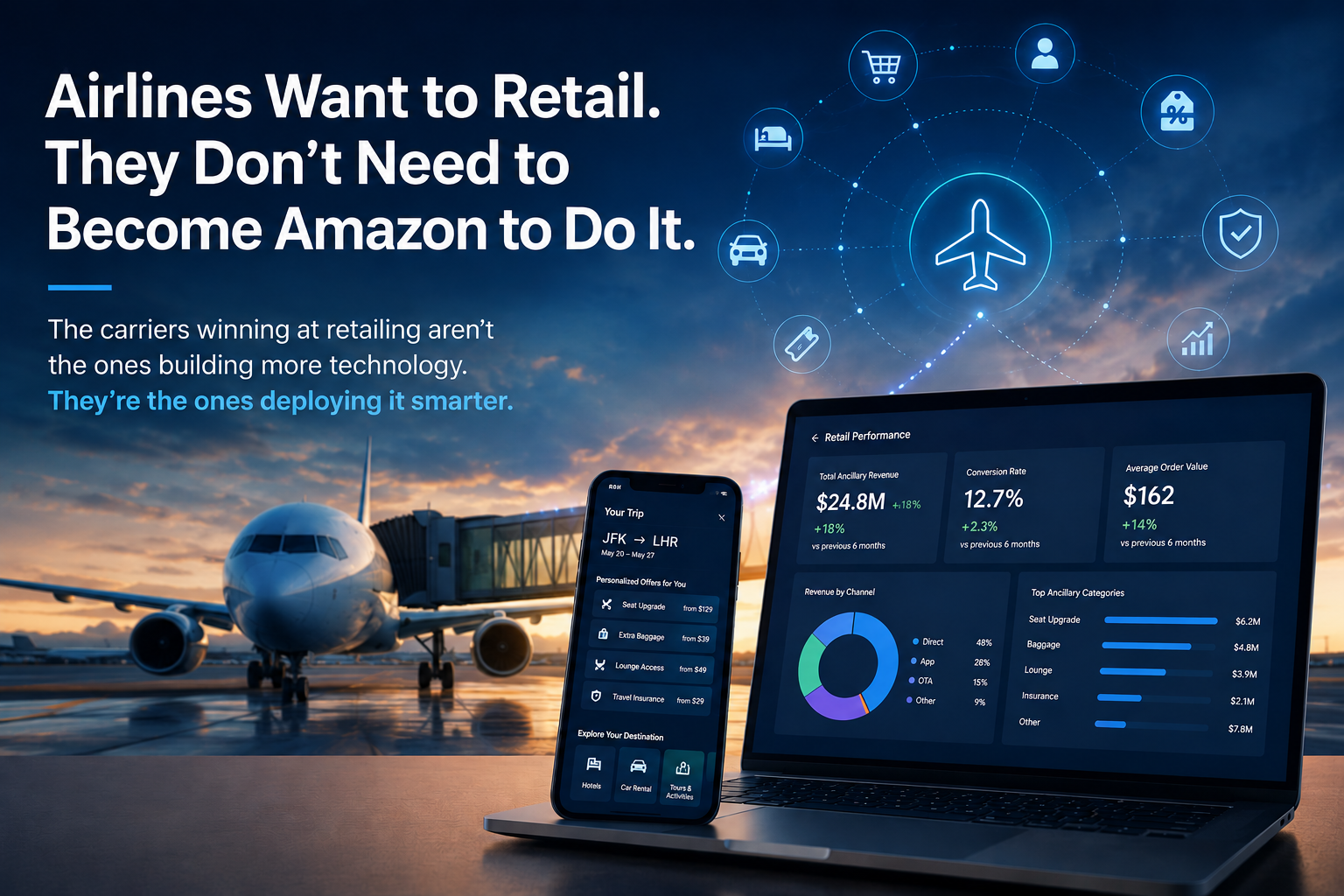
Every airline wants to retail better. That ambition is right. Travelers expect the same personalized, seamless shopping experience they get from Amazon, Uber, or Netflix.
But wanting to retail like Amazon and deciding to build like Amazon are two very different choices. Most airlines confuse them. That confusion costs years and millions.
Here's the distinction that matters.
Delivering what travelers want, while satisfying regulators, finance teams, and fraud teams, requires a retail engine built for real-world scale. That means:
Each piece is specialized. Together, they form a retail operation that must be stable, flexible, and built for the peaks and valleys that define airline commerce.
The pattern repeats across the industry. Airlines spend years and tens of millions building in-house or stitching together siloed vendors. The outcome rarely matches the vision.
The industry has learned this firsthand: NDC has opened the door to better retailing, but a messaging standard alone doesn't close the sale. Without the right infrastructure behind it, even the best offers can't reach the traveler at the moment of truth. The gap between NDC certification and actual retail performance is where most airlines get stuck.
Owning your retail strategy is essential. Owning every line of code is not.
Leading airlines focus on what they do best: designing the customer experience, setting pricing strategy, and defining their branded offers. They use partners for the flexible, scalable infrastructure that brings that vision to life.
The carriers that try to do everything in-house spend their energy on infrastructure problems. The ones who leverage the right partners spend their energy on strategy.
TWAI is built for airlines that are done waiting. Our modular, API-driven platform slots into your existing stack, adapts as your retail strategy evolves, and starts generating value without a multi-year build:
High-margin non-air content, ready on day one. Hotels, ground transport, tours, and activities are available through our marketplace from launch. No supplier negotiations to start. No aggregator build required. Inventory that fits your booking flow and generates revenue from the first transaction.
Everything runs on cloud-native architecture designed to flex when traffic spikes. No multi-year builds. No brittle bolt-ons. The building blocks that help you sell smarter, faster, and at scale.
The following scenario is illustrative, drawn from the common trajectory we see when airlines shift from a DIY build to a partnership model.
A mid-sized carrier spends five years building a dynamic pricing engine in-house. Delays compound. Technical debt grows. The system buckles during a major fare sale.
They shift to a partnership model. Within 12 months, best-in-class offer management is live, integrated with their legacy PSS and loyalty systems. It scales through seasonal peaks. Fares adjust daily. Bookings climb 18% in six months.
They didn't lose control. They gained it. By focusing on retail strategy instead of infrastructure, they moved faster and performed better.
This isn't an outlier. It reflects what we see repeatedly when airlines make the shift from DIY infrastructure to a focused partnership model.
Airlines that retail well aren't the ones that built the most. They're the ones that made the right calls about what to build, what to buy, and who to trust.
You need partners who understand airline retailing and bring technology built for the real world: the peaks, the promotions, the complexity.
That's how the industry breaks free from outdated models. That's how airlines finally retail like the best.
The case for smarter airline retailing isn't theoretical. The data makes it concrete.
Global airline ancillary revenue in 2025, up from $109.5 billion pre-pandemic. Airlines have learned to sell beyond the seat. The ceiling is higher than most realize.
Air ticket offers sold in 2024 were dynamically created, regardless of sophistication. The vast majority of flight prices still rely on static price points and predetermined booking classes. That gap is unrealized revenue.
McKinsey's estimate of the incremental value personalized bundling and dynamic pricing could unlock for airlines by 2030. That translates to 2 to 3 percent of revenue, or up to 15 percent of EBITDA, per carrier.
Share of ARC-settled air transactions using NDC as of late 2025, up from near zero five years ago. Adoption is real and accelerating. But more than three-quarters of bookings still travel over legacy pipes, leaving personalized offer delivery out of reach for most itineraries.
Current size of the global tours and activities reservations market, growing at 7.5% annually toward $267 billion by 2030. Airlines sit at the start of the traveler journey. That spend is reachable.
TWAI helps airlines, travel sellers, and loyalty providers deliver modern retailing through modular APIs, resilient infrastructure, and deep aviation expertise. Ready to build a retail operation that holds up when it matters most? Let's talk.twai.com